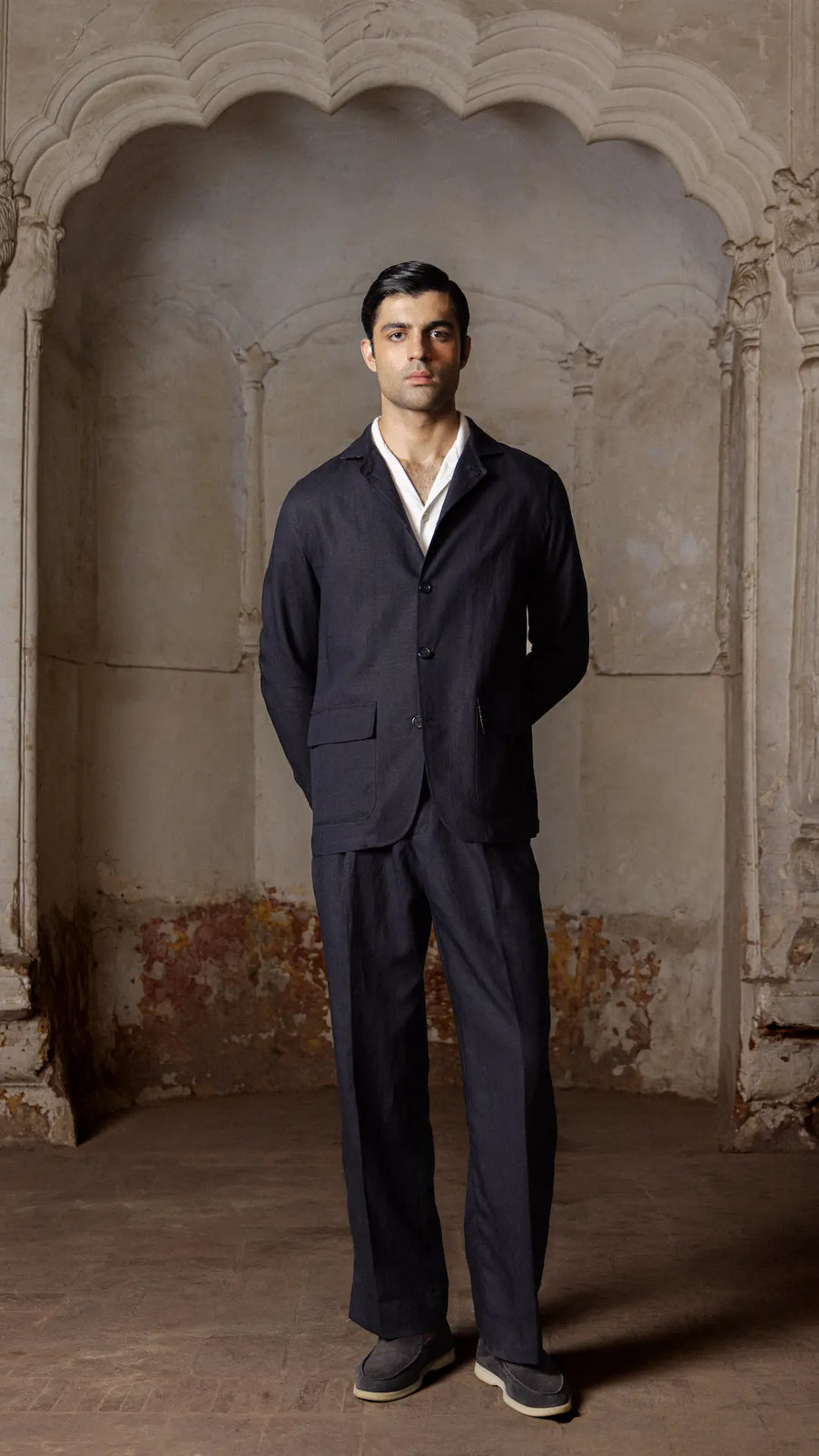
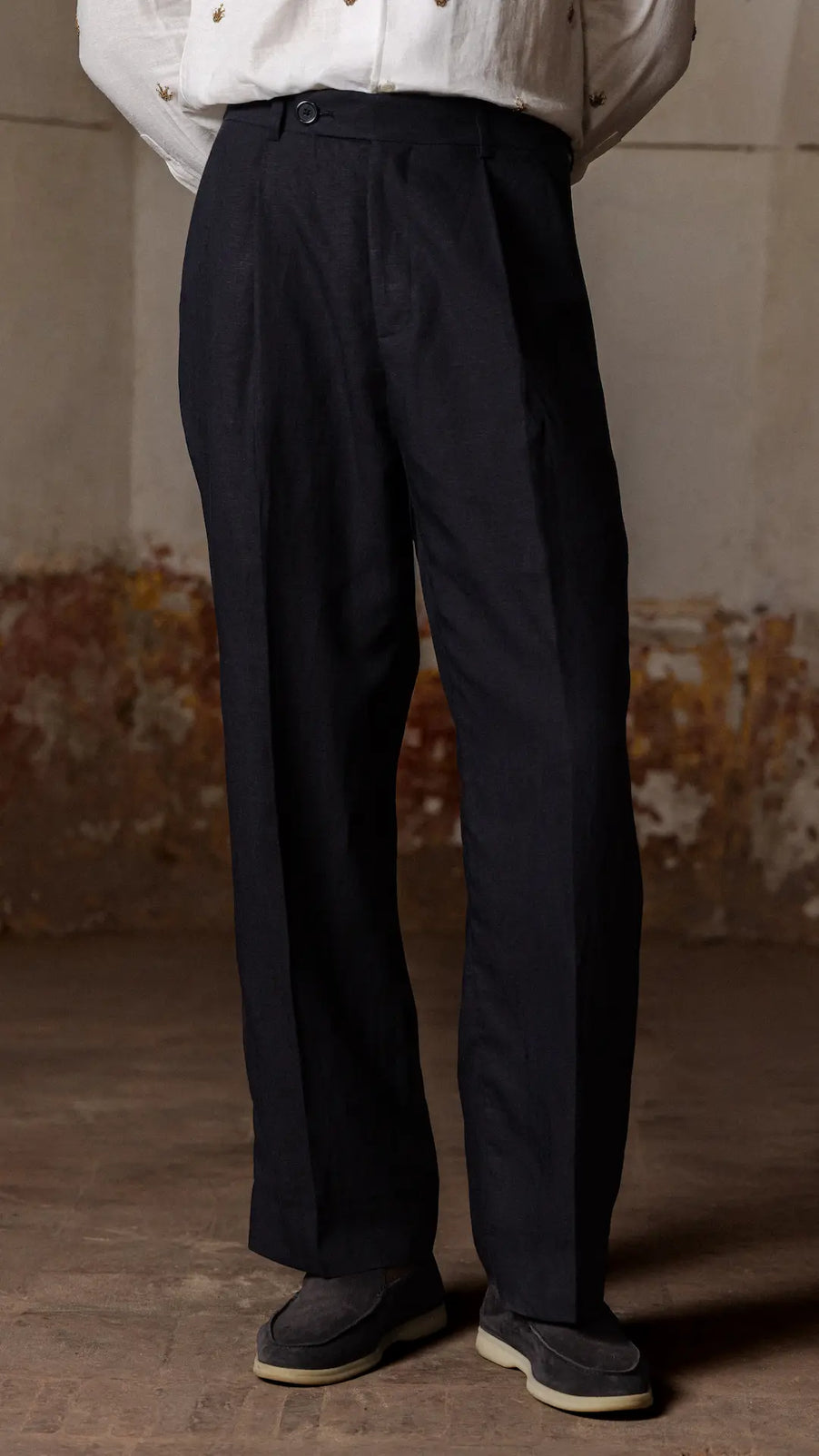
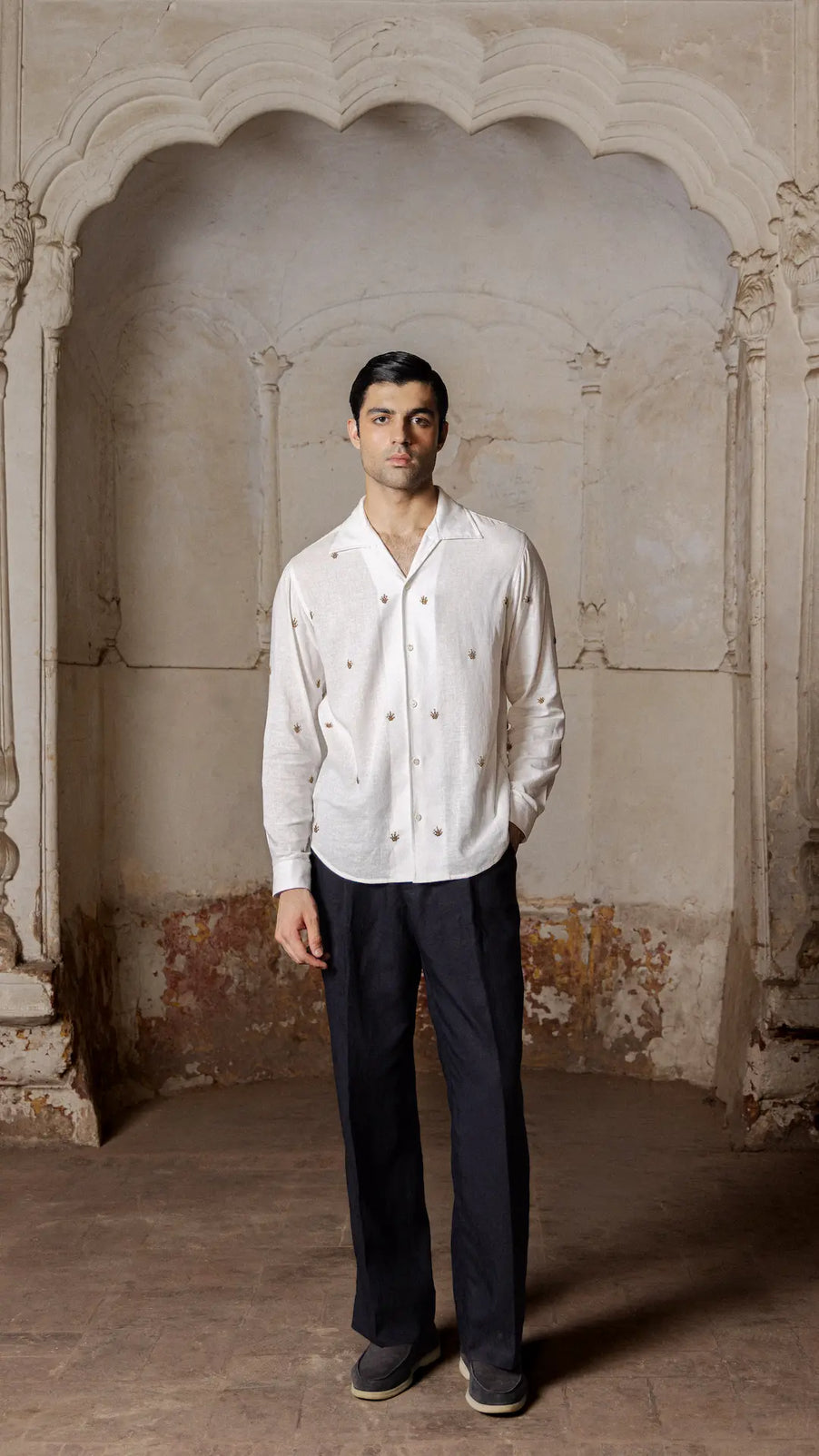
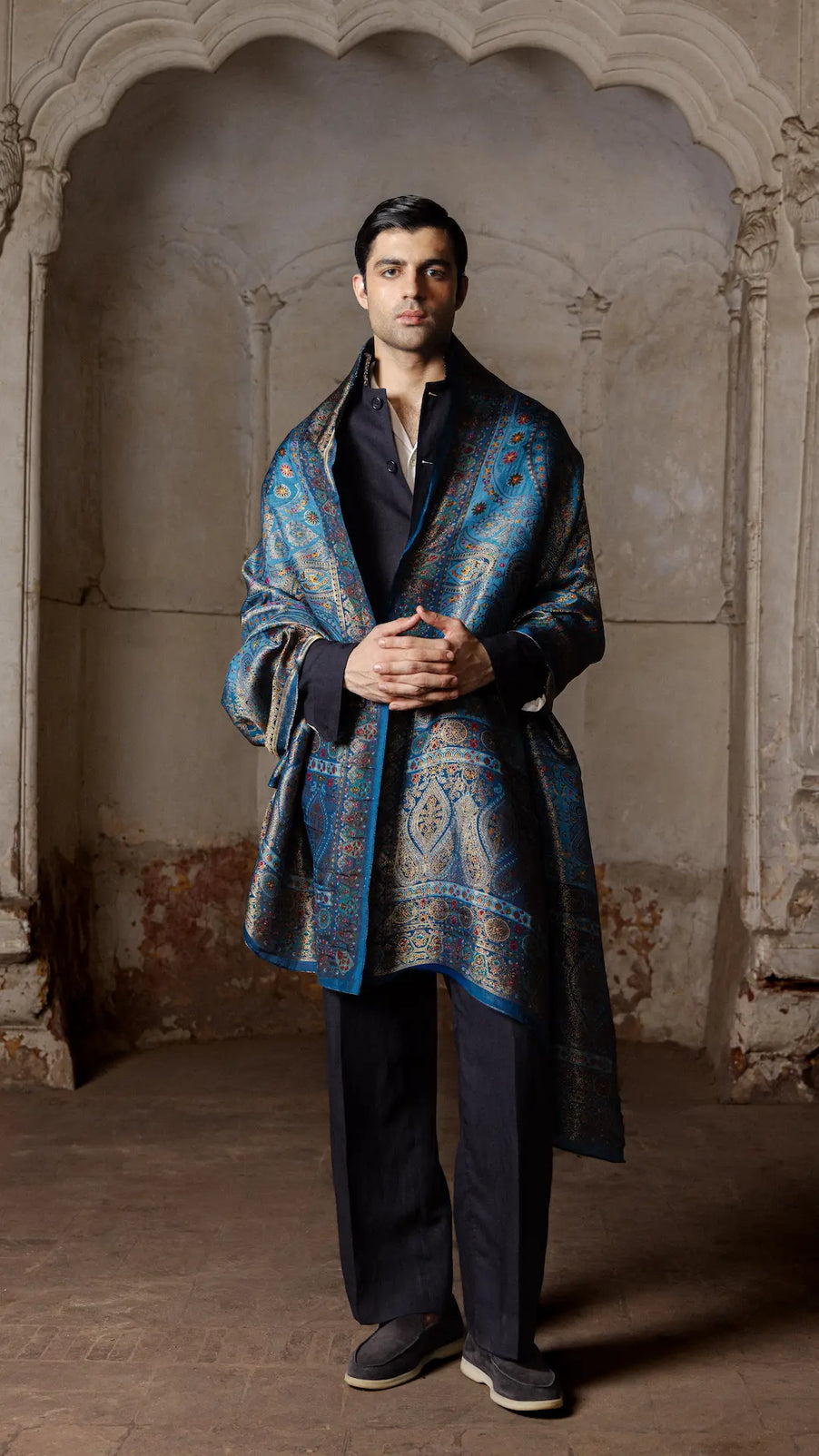
A white couch, in Lahore, in June.
That’s the room. My family’s lounge, corner windows, curtains pulled open — because nobody in my family has ever been willing to give up the light, even when the light is the problem. Sun coming in at an angle and bleeding across the floor. AC running hard. Something on the TV that nobody is actually watching. And in the middle of all of it, a plate of mango slices, and everyone eating them very, very carefully, because the couch is white and we all understand exactly what’s at stake.
That’s summer to me. Not a beach. That room.
Go back far enough and it’s the same room in a different house. My Nani’s place. Same corner, same shape of couch, no AC — just the ceiling fan turning slow overhead and a hand fan moving in somebody’s lap. And past the doorway, the aangan out back. Marble floor. Vines climbing the whole wall. A courtyard doing precisely what courtyards were built to do.
Two rooms, two generations, same problem, solved twice.
Here’s the important part: nobody in either room was suffering. Nobody was enduring anything. They were sitting in the heat, dressed properly, eating fruit, taking their time. That is not survival.
That’s leisure. We just never called it that.
I’ve been thinking more about that idea since the last letter, and it turned into the whole thesis for what comes next. So let me lay it out properly for you.
1. Resort wear is about a hundred years old.
Not the clothes. The category.
“Resort” as a fashion idea was invented in the early twentieth century, when wealthy Americans and Europeans started spending winters somewhere warm — Palm Beach, the French Riviera — and discovered that their heavy northern wardrobes were useless there. Chanel showed a cruise line in 1919. Patou followed. By the thirties it was a proper commercial season with its own marketing.
Sit with the premise for a second. The entire genre exists because cold-weather people needed something to wear on holiday in a hot place.
That’s the origin. Not a climate. A vacation.
And everything downstream inherited it — the linen, the light, the long lunch, the man doing nothing beautifully. Every resort campaign you’ve ever seen is descended from that one specific problem: what do northern people wear when they visit the sun for a season.
A hundred years. That’s it. That’s the whole tradition.
2. We were not visiting.
Cotton has grown across the plains of Punjab and Sindh for centuries, and the climate decided everything about how it was used — light weaves for summer, heavier ones for winter. Khaddar, the plainest handspun cotton of the region, was one of Punjab’s serious exports until about a century ago; the finest of it came out of Lahore, Multan, Jhang, Sargodha, Kasur, Jhelum. Malmal khaddar was what you made a good kurta from.
None of that was a seasonal collection. It was infrastructure.
And it wasn’t only cloth. The loose cut that lets air move instead of trapping it. The marble floor that stays cold under your feet at three in the afternoon. The courtyard that pulls air down into the middle of a house. The fan in your hand. The hour where nobody schedules anything because everyone knows better.
That’s a complete system for living well in heat, built by people who were not going home in September.
I want to be careful here, because there’s a lazy version of this argument — the one where you wave at “ancient wisdom” and expect the sentence to do the rest of the work. That’s not what I mean. I mean something narrower and more useful: the specific design problems that resort wear was invented to solve in 1919 had already been solved, at a high level of refinement, by people who had no choice but to solve them. Not spiritually. Technically. In the cut, in the weave, in the weight.
3. We were the luxury before we were the labor.
This is the part that took me a while to figure out how to articulate.
Two hundred years ago the finest cotton on earth came from this subcontinent. Dhaka muslin — not my city, not my province, but the same story — was woven at warp densities of eight hundred to twelve hundred threads per inch. Modern fine muslin rarely gets past a hundred. It was traded to Mughal courts and then to European ones; it turns up on Marie Antoinette and in Jane Austen’s wardrobe. It was called woven air, and it was ours.
Then the East India Company took Bengal, and colonial policy did what colonial policy does. Machine-made imports flooded in. Tariffs went the wrong way. Cotton cultivation was encouraged — for export, as raw material — while the industries that used to spin and weave it were dismantled. The particular cotton plant that made muslin possible went extinct. And the knowledge along with it.
Today Bangladesh is one of the largest garment manufacturing economies on earth, sewing for brands that are not Bangladeshi. The region that produced the most valuable textile in the world now produces the cheapest.
That’s not a tragedy in the abstract. That’s a specific reversal, done deliberately, within recorded history, and it explains the thing I got stuck on at the end of the last letter. I said we were present in the production and absent from the leisure. That’s true, but it’s the polite version.
The full version is that we were the luxury first. Then we were made the factory.
4. What got taken wasn’t the cloth.
Because here’s the strange part — the clothes survived. All of them. The kurta is still here. The shalwar, the wrap, the khaddar, the loose fit, the courtyard, the fan. Nothing was actually lost at the level of the garment. My Nani’s house had the entire system running in it, correctly, with no AC, almost 20+ years ago in 2004.
What got taken was the frame around it.
Somewhere along the line, a linen shirt on a man in Antibes became style, and effectively the same shirt on a man in Lahore became traditional dress. Same fabric, same physics, same problem being solved. One reads as taste. The other reads as heritage — which in fashion is really just a polite way of saying it belongs in the past.
So we kept the clothes and lost the picture. We have the wardrobe and none of the photographs. And two generations of us grew up assuming that looking good in heat was something you learned from somewhere else, when it was sitting in your Nani’s back courtyard the entire time.
That’s the gap I’ve been building into. Not a lack of craft. A lack of frame.
5. So: Lahori Riviera.
That’s the name of what’s coming. It’s the lens the first rebranded release sits inside, and I’ve gone back and forth on whether to say it out loud this early, but it’s the argument, so here it is.
I know Lahore has no coast. That contradiction is the point, and I’d rather name it than have someone else point it out.
Riviera has never really meant water. It means a posture — the permission to be at ease, in heat, in public, dressed well, with nowhere urgent to be. By that definition Lahore has been a riviera for centuries. It just has canals instead of a coastline, courtyards instead of terraces, roofs instead of decks. And Pakistan does in fact have a coast, hundreds of kilometres of it, which almost nobody has ever bothered to photograph as leisure.
So, Lahori Riviera is not Lahore meeting the Riviera. It’s not a mashup, and it’s not East-meets-West, which is a phrase I’d like to retire. It’s a correction. It’s the claim that the thing the Riviera is famous for was already happening here, at a very high level, and simply never got its own visual language.
I’m not inventing anything. I’m just trying to put a camera where one hasn’t been.
The next stretch of writing goes deeper into each piece of that — the cut, the weave, the specific choices, and the men this is actually for. I’ll take my time with it, the way I said I would.
If you’ve been reading since the fruit market, or since October, or since last week: shukriya. The room’s better with you in it.
If you want to be closer to this than a letter allows, Osami & Friends is where that happens.
Otherwise — go enjoy your chai. Preferably somewhere with a fan and nothing urgent.
— Osama